

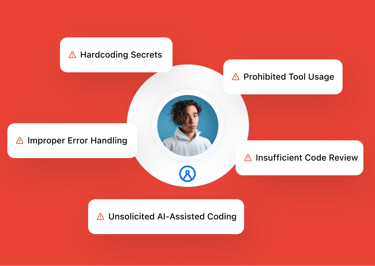
Developer monitoring refers to the collection of developer activity signals that provide context into how code, tools, and workflows are used across the SDLC.
On its own, monitoring is insufficient. Its value comes from how those signals are correlated to risk, attribution, and remediation.
Developer Security Posture Management (DevSPM) provides a structured way to translate developer activity into actionable security insights—linking scan results, tools, and actions to developer identity across the SDLC.
Analyzing how risks emerge during development is critical for preventing security incidents. Developer-related risks often arise from errors, subpar practices, or malicious intent, making Developer Monitoring an essential part of any security strategy.
Developer risk commonly arises from:
Insider threats, such as compromised credentials or misuse of access
Shadow IT, introduced through unapproved tools or environments
Risky practices, including insecure AI-generated code or unverified dependencies
When these actions cannot be attributed, risks accumulate without clear ownership.
Developer Security Posture Management uses developer-level telemetry to provide the context needed to identify root cause, triage incidents faster, and route remediation to the right owners.
Real-world incidents consistently demonstrate that unmanaged developer actions and limited visibility into developer security posture increase organizational risk—reinforcing the need for developer-aware security.:
Insider Threats and Identity Mismanagement, Uber Breach (2022):
Compromised developer credentials allowed a hacker to gain access to sensitive systems, demonstrating the importance of monitoring developer activity to prevent insider threats.
AI Code Vulnerabilities, GitHub Copilot Security Flaw (2024):
Researchers revealed that AI tools like GitHub Copilot occasionally suggest insecure code snippets if your existing codebase contains security issues, underscoring the need to monitor and govern AI-driven code development.
Archipelo integrates into existing development workflows—via CI/CD, browser, and IDE extensions—to create a historical record of coding events tied to developer identity and actions. Archipelo strengthens existing ASPM and CNAPP programs by adding developer-aware visibility, attribution, and accountability.
Core Archipelo Capabilities:
Developer Vulnerability Attribution
Trace vulnerabilities and scan results to the developers and AI agents who introduced them.Automated Developer & CI/CD Tool Governance
Verify developer and CI/CD tool usage to mitigate shadow IT and unapproved services.AI Code Usage & Risk Monitor
Monitor AI-assisted development to ensure secure and responsible software development.Developer Security Posture
Generate insights into security risks introduced by developer actions across teams.
Without developer-level visibility, organizations face:
Vulnerabilities with no clear owner
Unapproved tools expanding the attack surface
Increased exposure from insecure development practices
Developer Security Posture Management makes developers observable—human and AI—so teams can address root cause, not just patch symptoms. Developer monitoring alone does not secure software. DevSPM uses developer-level telemetry to connect actions to risk—giving organizations the clarity needed to reduce developer risk across the SDLC.
Archipelo delivers developer-level visibility and actionable insights to strengthen security and foster a culture of secure development. Contact us to learn how Archipelo helps teams reduce developer risk across the SDLC while aligning with DevSecOps principles.